gptme - agent in your terminal

gptme
/ʤiː piː tiː miː/
Getting Started • GitHub • Documentation







📜 Personal AI assistant/agent in your terminal, with tools so it can:
Use the terminal, run code, edit files, browse the web, use vision, and much more;
a great coding agent, but is general-purpose to assists in all kinds of knowledge-work, from a simple but powerful CLI.
An unconstrained local alternative to: ChatGPT with "Code Interpreter", Cursor Agent, etc.
Not limited by lack of software, internet access, timeouts, or privacy concerns (if using local models).
📚 Table of Contents
🎥 Demos
Note
These demos are very out of date (2023) and do not reflect the latest capabilities.
| Fibonacci | Snake with curses |
|---|---|
Steps
|
Steps
|
| Mandelbrot with curses | Answer question from URL |
Steps
|
Steps
|
| Terminal UI | Web UI |
Features
|
Features
|
You can find more Demos and Examples in the documentation.
🌟 Features
- 💻 Code execution
- 🧩 Read, write, and change files
- Makes incremental changes with the patch tool.
- 🌐 Search and browse the web.
- Can use a browser via Playwright with the browser tool.
- 👀 Vision
- Can see images referenced in prompts, screenshots of your desktop, and web pages.
- 🔄 Self-correcting
- Output is fed back to the assistant, allowing it to respond and self-correct.
- 📚 Lessons system
- Contextual guidance and best practices automatically included when relevant
- Keyword and tool-based matching
- Adapts to interactive vs autonomous modes
- 🤖 Support for several LLM providers
- Use OpenAI, Anthropic, OpenRouter, or serve locally with
llama.cpp
- Use OpenAI, Anthropic, OpenRouter, or serve locally with
- 🌐 Web UI and REST API
- Modern web interface at chat.gptme.org (gptme-webui)
- Simple built-in web UI included in the Python package
- Server with REST API
- Standalone executable builds available with PyInstaller
- 💻 Computer
use tool, as hyped by Anthropic
(see #216)
- Give the assistant access to a full desktop, allowing it to interact with GUI applications.
- 🤖 Long-running agents and advanced agent architectures (see #143 and #259)
- Create your own agent with persistence using gptme-agent-template, like Bob.
- ✨ Many smaller features to ensure a great experience
- 🚰 Pipe in context via
stdinor as arguments.- Passing a filename as an argument will read the file and include it as context.
- → Smart completion and highlighting:
- Tab completion and highlighting for commands and paths
- 📝 Automatic naming of conversations
- ✅ Detects and integrates pre-commit
- 🗣️ Text-to-Speech support, locally generated using Kokoro
- 🔊 Tool sounds: Pleasant notification sounds for different tool
operations
- Enable with
GPTME_TOOL_SOUNDS=true - Different sounds for shell commands, file operations, screenshots, etc.
- Enable with
- 🎯 Feature flags for advanced usage, see configuration docs
- 🚰 Pipe in context via
🛠 Use Cases
- 🖥 Development: Write and run code faster with AI assistance.
- 🎯 Shell Expert: Get the right command using natural language (no more memorizing flags!).
- 📊 Data Analysis: Process and analyze data directly in your terminal.
- 🎓 Interactive Learning: Experiment with new technologies or codebases hands-on.
- 🤖 Agents & Tools: Experiment with agents & tools in a local environment.
🛠 Developer perks
- ⭐ One of the first agent CLIs created (Spring 2023) that is still in active development.
- 🧰 Easy to extend
- 🧪 Extensive testing, high coverage.
- 🧹 Clean codebase, checked and formatted with
mypy,ruff, andpyupgrade. - 🤖 GitHub Bot to
request changes from comments! (see #16)
- Operates in this repo! (see #18 for example)
- Runs entirely in GitHub Actions.
- 📊 Evaluation suite for testing capabilities of different models
- 📝 gptme.vim for easy integration with vim
🚧 In progress
- 🌳 Tree-based conversation structure (see #17)
- 📜 RAG to automatically include context from local files (see #59)
- 🏆 Advanced evals for testing frontier capabilities
🚀 Getting Started
Install with pipx:
# requires Python 3.10+
pipx install gptme
Now, to get started, run:
gptmeHere are some examples:
gptme 'write an impressive and colorful particle effect using three.js to particles.html'
gptme 'render mandelbrot set to mandelbrot.png'
gptme 'suggest improvements to my vimrc'
gptme 'convert to h265 and adjust the volume' video.mp4
git diff | gptme 'complete the TODOs in this diff'
make test | gptme 'fix the failing tests'
For more, see the Getting Started guide and the Examples in the documentation.
🛠 Usage
$ gptme --help
Usage: gptme [OPTIONS] [PROMPTS]...

  gptme is a chat-CLI for LLMs, empowering them with tools to run shell
  commands, execute code, read and manipulate files, and more.

  If PROMPTS are provided, a new conversation will be started with it. PROMPTS
  can be chained with the '-' separator.

  The interface provides user commands that can be used to interact with the
  system.

  Available commands:
    /undo         Undo the last action
    /log          Show the conversation log
    /edit         Edit the conversation in your editor
    /rename       Rename the conversation
    /fork         Create a copy of the conversation
    /summarize    Summarize the conversation
    /replay       Replay tool operations
    /export       Export conversation as HTML
    /model        List or switch models
    /tokens       Show token usage and costs
    /context      Show context token breakdown
    /tools        Show available tools
    /commit       Ask assistant to git commit
    /compact      Compact the conversation
    /impersonate  Impersonate the assistant
    /restart      Restart gptme process
    /setup        Setup gptme
    /help         Show this help message
    /exit         Exit the program

  See docs for all commands: https://gptme.org/docs/commands.html

  Keyboard shortcuts:
    Ctrl+X Ctrl+E  Edit prompt in your editor
    Ctrl+J         Insert a new line without executing the prompt

Options:
  --name TEXT            Name of conversation. Defaults to generating a random
                         name.
  -m, --model TEXT       Model to use, e.g. openai/gpt-5, anthropic/claude-
                         sonnet-4-20250514. If only provider given then a
                         default is used.
  -w, --workspace TEXT   Path to workspace directory. Pass '@log' to create a
                         workspace in the log directory.
  --agent-path TEXT      Path to agent workspace directory.
  -r, --resume           Load most recent conversation.
  -y, --no-confirm       Skip all confirmation prompts.
  -n, --non-interactive  Non-interactive mode. Implies --no-confirm.
  --system TEXT          System prompt. Options: 'full', 'short', or something
                         custom.
  -t, --tools TEXT       Tools to allow as comma-separated list. Available:
                         append, browser, chats, choice, computer, gh,
                         ipython, morph, patch, rag, read, save, screenshot,
                         shell, subagent, tmux, tts, vision, youtube.
  --tool-format TEXT     Tool format to use. Options: markdown, xml, tool
  --no-stream            Don't stream responses
  --show-hidden          Show hidden system messages.
  -v, --verbose          Show verbose output.
  --version              Show version and configuration information
  --help                 Show this message and exit.
📊 Stats
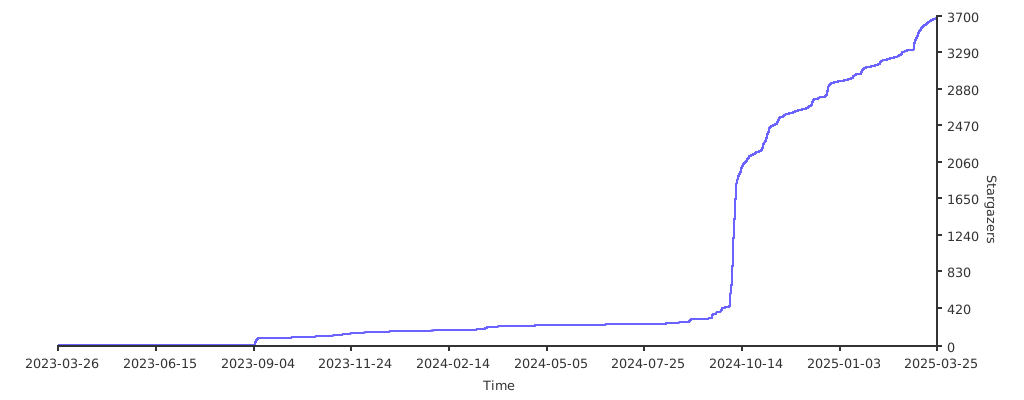
⭐ Stargazers over time