📜 A personal AI agent that runs anywhere a terminal runs — your laptop,
ssh sessions, tmux, headless servers, CI pipelines.
Provider-agnostic, local-first, and unconstrained: ships with shell, Python, web,
vision, and everything else an agent needs.
A great coding agent, but general-purpose enough to assist in all kinds of knowledge-work.
Free and open-source. Works with Anthropic, OpenAI, Google, SpaceXAI, DeepSeek, OpenRouter, Requesty,
your existing ChatGPT/SuperGrok subscription, or fully local via Ollama and any
OpenAI-compatible server — your data, your models, your terminal.
A capable alternative to Claude Code,
Codex, and Grok Bot, and a development-focused peer to self-hosted agents like OpenClaw
and Hermes Agent — one of the first agent CLIs (Spring 2023), still in very active
development.
📚 Table of Contents
- 📢 News
- 🎥 Demos
- 🌟 Features
- 🚀 Getting Started
- 🛠 Usage
- 🌍 Ecosystem
- 🏷️ Repository Badge
- 💬 Community
- 📊 Stats
- 📝 Citation
- 🔗 Links
- ❓ FAQ
📢 News
- 2026-09 - v0.34.0: Cross-harness memory (
gptme-util memory, Claude Code & Codex integration), skills as slash commands,gptme service initfor headless agents, context-scout pre-pass - 2026-08 - v0.33.0: Hashline edit format, sandboxed Python/shell execution (Docker, Wasmtime), non-interactive exit taxonomy,
gptme explain, server auth hardening - 2026-07 - v0.32.0 & v0.32.1: Desktop app for Linux (AppImage), macOS, and Windows, with auto-updates since v0.32.1 — download here; ACP support, MCP server, Textual TUI; gptme.ai cloud service
- 2026-05 - gptme-plugin-registry created: central registry for plugin discovery
- 2026-02 - Scheduled dev pre-releases begin
- 2026-01 - gptme-agent-template v0.4: Bob has run extensively as an autonomous agent, autonomous run loops, enhanced context generation
- 2025-12 - v0.31.0: Background jobs, form tool, cost tracking, content-addressable storage
- 2025-11 - v0.30.0: Plugin system, context compression, subagent planner mode
- 2025-10 - v0.29.0: Lessons system for contextual guidance, MCP discovery & dynamic loading, token awareness; Bob begins autonomous runs with GitHub monitoring
- 2025-08 - v0.28.0: MCP support, morph tool for fast edits, auto-commit, redesigned server API
- 2025-03 - v0.27.0: Pre-commit integration, macOS computer use, Claude 3.7 Sonnet, DeepSeek R1, local TTS with Kokoro
- 2025-01 - gptme-contrib created: community plugins including Twitter/X, Discord bot, email tools, consortium (multi-agent)
- 2024-12 - gptme-agent-template v0.3: Template for persistent agents
- 2024-11 - Ecosystem expansion: gptme-webui, gptme-rag, gptme.vim, Bob created (first autonomous agent)
- 2024-10 - First viral tweet bringing widespread attention
- 2024-08 - Show HN, Anthropic Claude support, tmux tool
- 2023-09 - Initial public release on HN, Reddit, Twitter
- 2023-03 - Initial commit - one of the first agent CLIs
For more history, see the Timeline and Changelog.
🎥 Demos
| Terminal UI | Web UI |
|---|---|
Features
|
Features
|
| Fibonacci | Mandelbrot with curses |
Steps
|
Steps
|
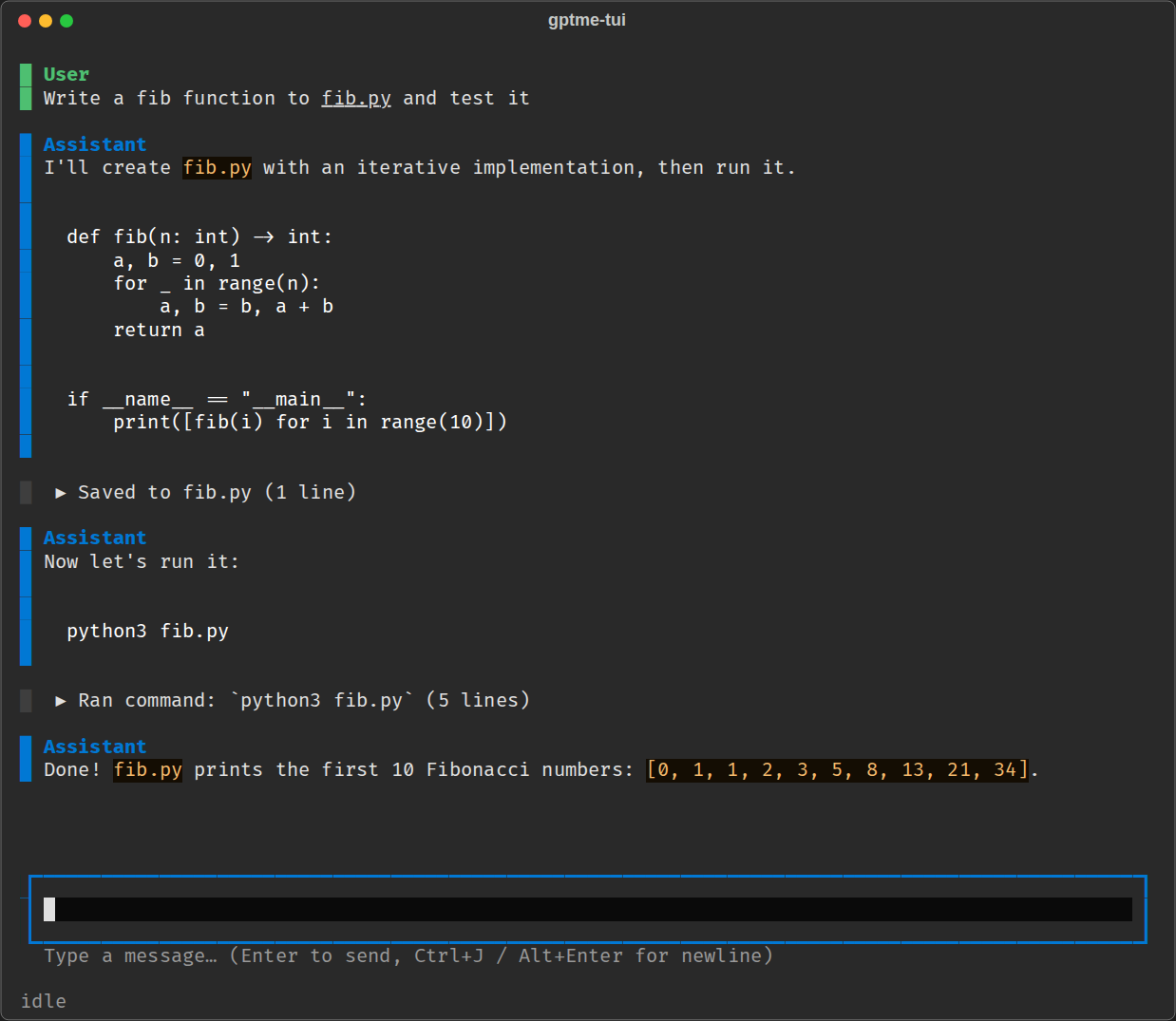
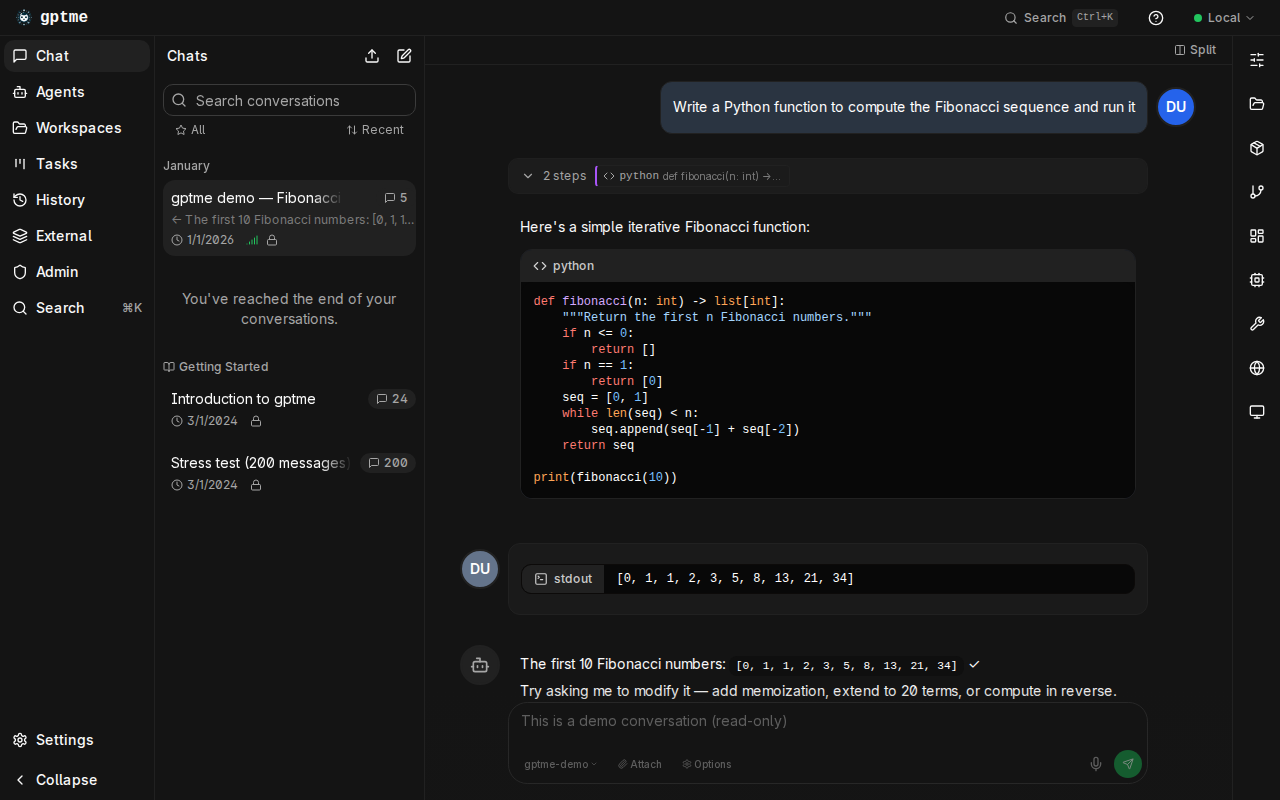
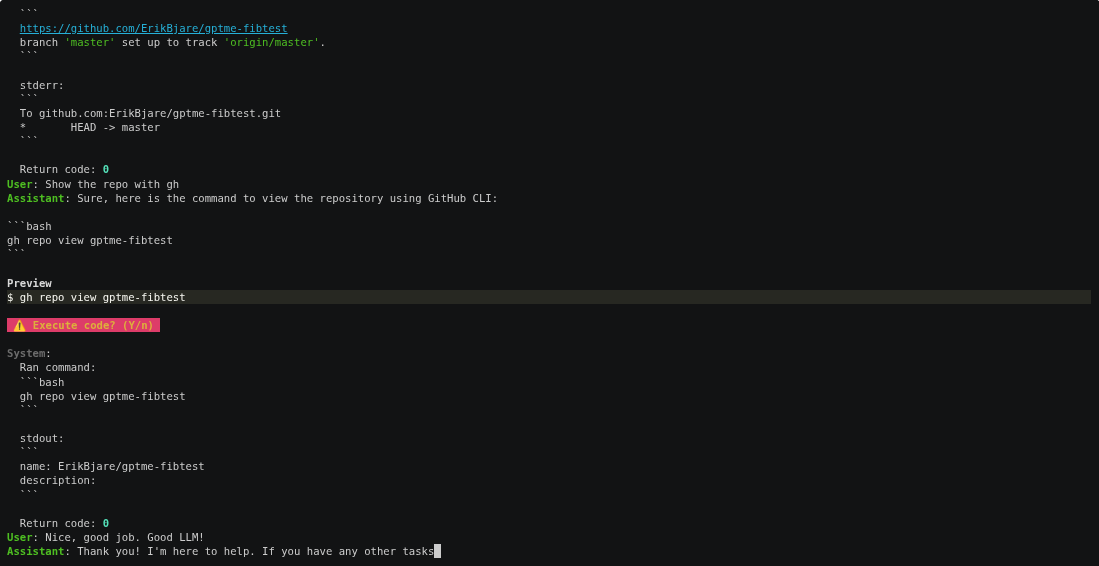
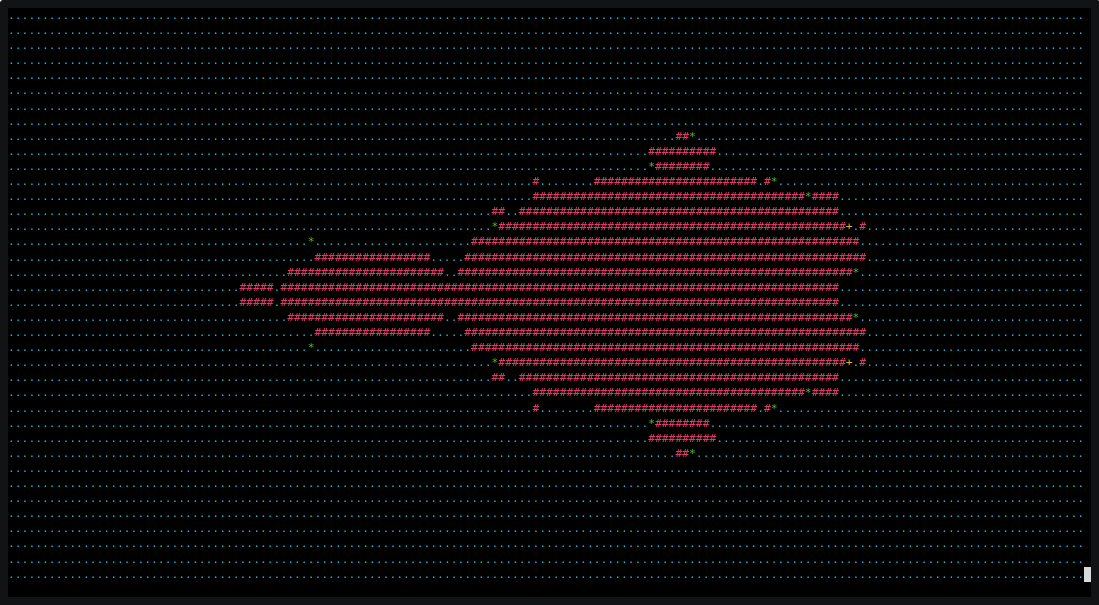
[!NOTE] The terminal recordings above are from 2023 and show the classic CLI. More recordings are kept in the Demo archive, and more up-to-date walkthroughs are in the Examples.
🌟 Features
- 💻 Code execution
- 🧩 Read, write, and change files
- Makes incremental changes with the patch tool.
- 🌐 Search and browse the web
- Can use a browser via Playwright with the browser tool.
- 👀 Vision
- Can see images referenced in prompts, screenshots of your desktop, and web pages.
- 🔄 Self-correcting
- Output is fed back to the assistant, allowing it to respond and self-correct.
- 📚 Lessons system
- Contextual guidance and best practices automatically included when relevant.
- Keyword, tool, and pattern-based matching.
- Adapts to interactive vs autonomous modes.
- Extend with your own lessons and skills.
- 🗃️ Cross-harness memory
- One local Markdown-based memory store shared by gptme, Claude Code, Codex, and any other harness.
gptme-util memoryCLI — save, recall, search, supersede, and audit entries from any terminal.- Claude Code hook and Codex AGENTS.md integration included.
- 🤖 Support for many LLM providers
- Anthropic (Claude), OpenAI (GPT), Google (Gemini), SpaceXAI (Grok), DeepSeek, and more.
- Use OpenRouter or Requesty for access to 100+ models, or serve locally with Ollama, LM Studio, vLLM, or
llama.cpp. - Bring your own subscription: use your existing ChatGPT Plus/Pro or SuperGrok plan instead of API keys (see providers).
- Pick the right model per task — fast/cheap for triage, powerful for coding.
- 🌐 Web UI and REST API
- Modern gptme-webui bundled with
gptme-serverand hosted at chat.gptme.org. - Server with REST API.
- Standalone executable builds available with PyInstaller.
- Modern gptme-webui bundled with
- 💻 Computer use
- Give the assistant access to a full desktop, allowing it to interact with GUI applications.
- 🧠 Code intelligence
- Structural code understanding with gptme-codegraph: call graphs, symbol extraction, and impact analysis powered by Tree-sitter. 10 MCP tools for codebase navigation.
- 🔊 Tool sounds — pleasant notification sounds for different tool operations.
- Enable with
GPTME_TOOL_SOUNDS=true.
- Enable with
🛠 Tools
gptme equips the AI with a rich set of built-in tools:
| Tool | Description |
|---|---|
shell |
Execute shell commands directly in your terminal |
ipython |
Run Python code with access to your installed libraries |
read |
Read files and directories |
save / append |
Create or update files |
patch / morph |
Make incremental edits to existing files |
browser |
Search and navigate the web via Playwright |
vision |
Process and analyze images |
screenshot |
Capture screenshots of your desktop |
rag |
Retrieve context from local files (needs the gptme-rag package) |
gh |
Interact with GitHub via the GitHub CLI |
tmux |
Run long-lived commands in persistent terminal sessions |
computer |
Full desktop access for GUI interactions |
subagent |
Spawn sub-agents for parallel or isolated tasks |
chats |
Reference and search past conversations |
memory |
Save and recall memory entries shared across harnesses |
lessons |
Look up contextual guidance and skills |
todo |
Keep a task list for the current conversation |
mcp |
Discover and load MCP servers at runtime |
Use /tools during a conversation to see all available tools and their status.
🔌 Extensibility: Plugins, Skills & Lessons
gptme has a layered extensibility system that lets you tailor it to your workflow:
Plugins — extend gptme with custom tools, hooks, and commands via Python packages:
# gptme.toml
[plugins]
paths = ["~/.config/gptme/plugins", "./plugins"]
enabled = ["my_plugin"]
Skills — lightweight workflow bundles (Anthropic format) that auto-load when mentioned by name. Great for packaging reusable instructions and helper scripts without writing Python.
Lessons — contextual guidance that auto-injects into conversations based on keywords, tools, and patterns. Write your own to capture team best-practices or domain knowledge.
Hooks — run custom code at key lifecycle events (before/after tool calls, on conversation start, etc.) without a full plugin.
gptme-contrib — community-contributed plugins, packages, scripts, and lessons:
| Plugin / Package | Description |
|---|---|
| gptme-codegraph | Structural code retrieval with tree-sitter: 10 MCP tools for parse, call graph, blast/impact analysis |
| gptme-consortium | Multi-model consensus decision-making |
| gptme-imagen | Multi-provider image generation |
| gptme-lsp | Language Server Protocol integration |
| gptme-ace | ACE-inspired context optimization |
| gptme-gupp | Work state persistence across sessions |
🔗 Integrations: MCP & ACP
MCP (Model Context Protocol) — gptme works in both directions:
- MCP client: discover and load external MCP servers as gptme tools.
- MCP server: expose gptme's persistent shell, Python REPL, and file tools to Claude Desktop, Cursor, or any other MCP client.
pipx install gptme  # MCP support included by default

# Run gptme as an MCP server over stdio
gptme-mcp-server --tools shell,ipython,save,read
The server keeps shell and Python state across tool calls. See the MCP docs for a ready-to-paste Claude Desktop configuration and MCP client setup.
ACP (Agent Client Protocol) — use gptme as a coding agent directly from your editor:
pipx install 'gptme[acp]'
This makes gptme available as a drop-in coding agent in Zed and JetBrains IDEs. Your editor sends requests, gptme executes with its full toolset (shell, browser, files, etc.) and streams results back.
🤖 Autonomous Agents
gptme is designed to run not just interactively but as a persistent autonomous agent — an AI that runs continuously, remembers everything, and gets better over time. The gptme-agent-template provides a complete scaffold:
- Persistent workspace — git-tracked "brain" with journal, tasks, knowledge base, and lessons
- Run loops — scheduled (systemd/launchd) or event-driven autonomous operation
- Task management — structured task queue with YAML metadata and GTD-style workflows
- Meta-learning — lessons system captures behavioral patterns and improves over time
- Multi-agent coordination — file leases, message bus, and work claiming for concurrent agents
- External integrations — GitHub, email, Discord, Twitter, RSS, and more
# Create and run your own agent
gptme-agent create ~/ada --name Ada
cd ~/ada
gptme-agent install   # runs on a schedule
gptme-agent status    # check on it
Headless Agents with systemd
For quick setup of a gptme agent as a persistent systemd service on any Linux machine, use gptme service init:
# Generate a complete headless agent setup
gptme service init --name Ada --model anthropic/claude-haiku-4-5 --work-dir ~/ada

# Install and start on a daily timer
systemctl --user daemon-reload
systemctl --user enable --now Ada.timer

# Update the schedule (--force overwrites all generated files, including gptme.toml and startup script)
gptme service init --name Ada --work-dir ~/ada --timer-schedule hourly --force
This command scaffolds:
- systemd service unit — runs your agent in a user session
- Optional timer — schedule autonomous runs (hourly, daily, weekly, or on-demand)
- Startup script — runs one non-interactive gptme session per trigger and writes a durable journal entry
- Session prompt —
prompt.md, the instruction the agent executes on every run - Skeleton config —
gptme.tomlandAGENTS.mdready to customize
The scaffolded workspace is self-contained and runs as generated — edit prompt.md to say what the agent should do each run; all you need is gptme installed. Perfect for automation, monitoring, CI/CD orchestration, or running background agents on headless servers.
See Running agents autonomously for scheduling, monitoring, and guardrails.
Bob is the reference implementation — created in late 2024 and running autonomously since 2025, with 5,000+ merged pull requests to his name. Bob opens PRs, reviews code, fixes CI, manages his own task queue, maintains a growing set of behavioral lessons, posts on Twitter, responds on Discord, and writes blog posts.
Multiple specialized agents can run in parallel — e.g. Bob (engineering) and Alice (personal assistant & orchestration) — coordinating through shared infrastructure.
See the Autonomous Agents docs for the full guide.
🛡 Guardrails
Persistent agents need guardrails around the full loop, not just tool permissions:
- Input guardrails — structured task selectors in the agent workspace keep work focused and reduce thrashing on notifications or ambiguous work. Bob uses a CASCADE-style selector for this layer.
- Pre-action guardrails — lessons inject situational guidance before the agent acts.
- Output guardrails — hooks and pre-commit checks validate file changes before control returns to the user.
This stack is simple and composable: selectors improve work choice, lessons steer behavior, and checks verify the result. You can add evals on top later, but the baseline guardrail loop already exists.
🛠 Use Cases
- 🖥 Development: Write and run code faster with AI assistance.
- 🎯 Shell Expert: Get the right command using natural language (no more memorizing flags!).
- 📊 Data Analysis: Process and analyze data directly in your terminal.
- 🎓 Interactive Learning: Experiment with new technologies or codebases hands-on.
- 🤖 Agents & Tools: Build long-running autonomous agents for real work.
- 🔬 Research: Automate literature review, data collection, and analysis pipelines.
🛠 Developer Perks
- ⭐ One of the first agent CLIs created (Spring 2023) that is still in active development.
- 🧰 Easy to extend
- 🧪 Extensive test suite, run on every PR.
- 🧹 Clean codebase, checked and formatted with
ruffandmypy. - 🤖 GitHub Bot to request changes from comments! (see #16)
- Operates in this repo! (see #18 for example)
- Runs entirely in GitHub Actions.
- 📊 Evaluation suite for testing capabilities of different models.
- 📝 gptme.vim for easy integration with vim.
🚧 In Progress
- ☁️ gptme.ai — managed cloud service for running gptme agents (early access; still self-hostable by running
gptme-server+gptme-webuiyourself) - 🏆 Advanced evals for testing frontier capabilities
🚀 Getting Started
Prerequisites
- Python 3.10 or newer
- Credentials for at least one LLM provider:
- Fastest no-credit-card path: start
gptme, choose OpenRouter in the startup provider setup (browser OAuth), then rungptme "hello" -m openrouter/openrouter/free. On an existing setup, use/account setup openrouterinside a session. See Getting Started. - Subscriptions work too: sign in with your ChatGPT Plus/Pro or SuperGrok plan
via
gptme-auth openai-subscriptionorgptme-auth grok-subscription, no API key needed (see providers docs). - You can also set API keys manually for Anthropic
(
ANTHROPIC_API_KEY), OpenAI (OPENAI_API_KEY), OpenRouter (OPENROUTER_API_KEY), and other providers. - Local models need no key at all — run Ollama (or any OpenAI-compatible server)
and use
-m local/<model>, see providers docs.
- Fastest no-credit-card path: start
Installation
For full setup instructions, see the Getting Started guide.
# With pipx (recommended, requires Python 3.10+)
pipx install gptme

# With uv
uv tool install gptme

# With optional extras
pipx install 'gptme[browser]'  # Playwright for web browsing
pipx install 'gptme[all]'      # Everything

# Latest from git with all extras
uv tool install 'git+https://github.com/gptme/gptme.git[all]'
Quick Start
gptme
You'll be greeted with a prompt. Type your request and gptme will respond, using tools as needed.
Example Commands
# Create a particle effect visualization
gptme 'write an impressive and colorful particle effect using three.js to particles.html'

# Generate visual art
gptme 'render mandelbrot set to mandelbrot.png'

# Get configuration suggestions
gptme 'suggest improvements to my vimrc'

# Process media files
gptme 'convert to h265 and adjust the volume' video.mp4

# Code assistance from git diffs
git diff | gptme 'complete the TODOs in this diff'

# Fix failing tests
make test | gptme 'fix the failing tests'

# Auto-approve tool confirmations (user can still watch and interrupt)
gptme -y 'run the test suite and fix any failing tests'

# Fully non-interactive: no prompts and no confirmations, for scripts/CI
# (every tool call runs unreviewed — scope its workspace and credentials accordingly)
gptme -n 'run the test suite and fix any failing tests'

# Machine-readable automation output (JSONL on stdout)
gptme --non-interactive --output-format json 'summarize the current git diff'
For more, see the Getting Started guide and the Examples in the documentation.
⚙️ Configuration
Create ~/.config/gptme/config.toml:
[user]
name = "User"
about = "I am a curious human programmer."
response_preference = "Don't explain basic concepts"

[prompt]
# Additional files to always include as context
# files = ["~/notes/llm-tips.md"]

[env]
# Set your default model
# MODEL = "anthropic/claude-sonnet-4-6"
# MODEL = "openai/gpt-5.6-sol"
For all options, see the configuration docs.
🛠 Usage
gptme                                   # start an interactive chat
gptme 'fix the failing tests'           # start with a prompt
gptme 'review this' main.py README.md   # include files (or URLs, or a GitHub PR) as context
gptme -m anthropic/claude-sonnet-4-6    # pick a model for this session
gptme -t read-only 'summarize the repo' # restrict which tools are available
gptme -y 'run the tests and fix them'   # auto-approve tool calls, stay in the loop
gptme -n 'summarize the git diff'       # fully non-interactive, for scripts and CI
gptme -r                                # resume the most recent conversation
During a conversation, /help lists the slash-commands — /undo, /backtrack,
/tools, /tokens, /compact, /model, and more. gptme --help shows every
flag, and gptme <subcommand> reaches the other CLIs (gptme tools list,
gptme chats search, gptme skills list).
Full reference: CLI docs · commands · usage guide · automation
🌍 Ecosystem
gptme is more than a CLI — it's a platform with a growing ecosystem:
| Project | Description |
|---|---|
| Web UI | Modern React web interface, available at chat.gptme.org |
| gptme-contrib | Community plugins, packages, scripts, and lessons |
| gptme-codegraph | Structural code retrieval with tree-sitter (10 MCP tools for code graph analysis) |
| gptme-agent-template | Template for building persistent autonomous agents |
| gptme-provider-template | Template for building custom LLM provider plugins |
| gptme-rag | RAG integration for semantic search over local files |
| gptme.vim | Vim plugin for in-editor gptme integration |
| Desktop app | Native app for Linux, macOS, Windows, and Android, built from this repo |
| gptme.ai | Managed cloud service (early access) |
Community agents powered by gptme:
- Bob — autonomous AI agent, created late 2024 and running autonomously since 2025, contributes to open source and manages his own tasks
- Alice — personal assistant & agent orchestrator, forked from the same architecture
🏷️ Repository Badge
This repo is maintained with gptme. To show your repo is AI-assisted with gptme, add the badge below.
[](https://gptme.org)
💬 Community
- Discord — ask questions, share what you've built, discuss features
- GitHub Discussions — longer-form conversation and ideas
- X/Twitter — updates and announcements
Contributions welcome! See the contributing guide.
📊 Stats
⭐ Stargazers over time
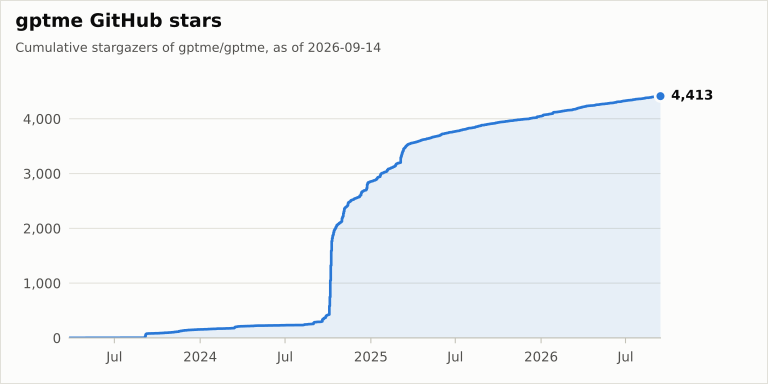
Community and usage numbers (stars, downloads, contributors) are collected daily in gptme/stats.
📈 Download Stats
📝 Citation
If you use gptme in your research, please cite it. The citation metadata lives in
CITATION.cff (GitHub's "Cite this repository" button uses it).
The Zenodo concept DOI identifies gptme
across all archived versions. For reproducibility, cite the version-specific DOI
from the Zenodo record for the release you used.
@software{gptme,
  author  = {Bjäreholt, Erik},
  title   = {gptme},
  year    = {2023},
  doi     = {10.5281/zenodo.22816651},
  url     = {https://github.com/gptme/gptme}
}
If you publish work that uses gptme, we'd love to hear about it on Discord.
🔗 Links
❓ FAQ
Short answers with pointers into the documentation — the docs are the source of truth, this section just gets you to the right page.
What is gptme?
gptme is a personal AI agent that runs anywhere a terminal runs — your laptop, SSH sessions, tmux, headless servers, CI pipelines. It's provider-agnostic, local-first, and unconstrained: ships with shell, Python, web, vision, and everything else an agent needs. Pronounced /ʤiː piː tiː miː/ like "GPT-ME".
See Features for the full picture.
How does gptme compare to other AI coding assistants?
gptme is open source and model-agnostic, runs in any terminal, and is built for persistent autonomous agents whose memory lives in a git repo you own — not just interactive pair programming.
It's compared two ways: against coding agents (Claude Code, Codex, Cursor, Cline, Aider, OpenHands) and against persistent personal agents (OpenClaw, Hermes Agent, Grok Bot, Devin). See Alternatives for the maintained tables.
How do I install it?
curl -sSf https://gptme.ai/install.sh | sh # auto-detects uv or pipx
Or install directly with pipx install gptme / uv tool install gptme (Python 3.10+).
See Installation above, the Getting Started guide,
and System dependencies for the extras individual tools need.
Do I need an API key?
No — you can also use a subscription you already pay for, or run a local model:
- Subscription:
gptme-auth openai-subscription(ChatGPT Plus/Pro) orgptme-auth grok-subscription(SuperGrok), then e.g.gptme -m openai-subscription/<model>. - Browser sign-in: pick OpenRouter in the startup setup (or
/account setup openrouter). - API keys:
ANTHROPIC_API_KEY,OPENAI_API_KEY,OPENROUTER_API_KEY,GEMINI_API_KEY,XAI_API_KEY,DEEPSEEK_API_KEY,GROQ_API_KEY,MOONSHOT_API_KEY, and more. - Local models: no credentials at all, see below.
If setup is missing or broken, run gptme-doctor --fix. Full provider list, model
prefixes, and setup details: Providers.
Can I run it fully locally?
Yes, against any OpenAI-compatible server (Ollama, LM Studio, vLLM, llama.cpp):
ollama pull llama3.2:3b && ollama serve
OPENAI_BASE_URL="http://127.0.0.1:11434/v1" gptme 'hello' -m local/llama3.2:3b
Put OPENAI_BASE_URL under [env] in ~/.config/gptme/config.toml to make it stick,
or define a named provider entry. Note that small local models are significantly less
capable at tool use. See Local & custom providers.
What tools does it have?
Shell, Python, file read/save/patch, browser, vision, computer use, tmux, subagents,
MCP, and more — run /tools in a conversation to see what's active in your setup.
See Tools for the full list and per-tool docs.
Does it support MCP?
Both directions: gptme consumes external MCP servers as tools, and gptme-mcp-server
exposes gptme's session-backed shell, Python, and file tools to Claude Desktop, Cursor,
and other MCP clients. See MCP. For editor integration (Zed, JetBrains),
gptme also speaks ACP.
How do I teach it my conventions and make it remember?
- Lessons — guidance auto-included when keywords, patterns, or tools match.
- Skills — portable knowledge bundles in the Agent Skills format, loaded by name.
- Memory — cross-harness memory entries shared with Claude Code and Codex.
- Plugins and hooks — custom tools, commands, and lifecycle code.
How do I create an autonomous agent?
gptme-agent create ~/ada --name Ada   # workspace from the agent template
gptme-agent install                            # run on a schedule (systemd/launchd)
The workspace is the agent: identity, journal, tasks, and lessons live in a git repo you own. See Agents for the full workflow and guardrails, and Bob for an agent that has been running autonomously since 2025.
How do I use gptme in scripts and CI?
Use -n/--non-interactive, which skips confirmations and exits when done:
git diff | gptme -n 'review this diff for bugs'
gptme -n --output-format json 'summarize the failing tests'   # JSONL on stdout
See Automation for GitHub Actions, cron, and systemd recipes,
or the GitHub bot for a ready-made @gptme PR/issue bot.
How do I configure it?
Configuration lives in ~/.config/gptme/config.toml (global), gptme.toml (per project),
and per-conversation settings; environment variables and CLI flags override them.
Set your default model with MODEL under [env], keep API keys in config.local.toml,
and use -v for verbose logging. See Configuration.
Where can I find more resources?
- Website: gptme.org
- Documentation: docs.gptme.org
- Examples: Examples
- Downloads: Downloads
- Discord: Discord Community
- Twitter: @gptmeorg
Happy Agent Building! 🤖